
Minnesota Court Records
Minnesota court records are public documents filed with the state's 87 district courts. You can search them online or visit any courthouse in the state. The Minnesota Court Records Online system covers all counties and lets you look up case filings, party names, and case status for free. For complete documents and certified copies, contact the Court Administrator in the county where the case was filed. This guide covers how to find Minnesota court records, what tools are available, and where to go depending on your case type.
Minnesota Court Records Overview
How to Search Minnesota Court Records Online
The main tool for finding Minnesota court records online is the Minnesota Court Records Online system, known as MCRO. It is run by the Minnesota Judicial Branch and covers all 87 counties. You can search without an account for basic case info. Full document access requires a login and a small per-document fee. MCRO lets you search by person name, business name, attorney name, case number, citation number, or attorney bar number. You can also look up court calendars and search judgments by debtor name.
The Minnesota Judicial Branch website is the starting point for all online court records searches in the state. From there, you can find courts by county, get to the MCRO portal, download forms, and access self-help guides.
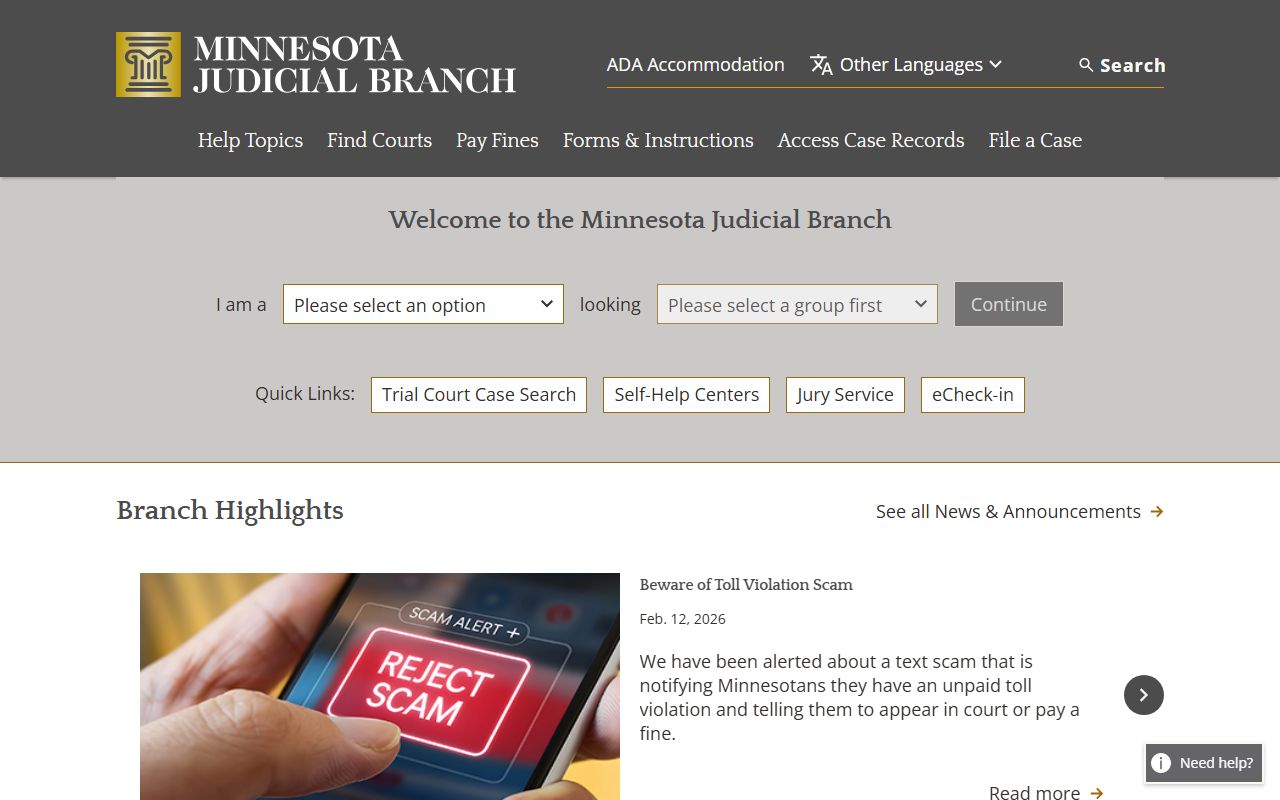
The Judicial Branch site connects you to every district court in the state and lets you get to records, pay fines online, and find court dates all in one place.
To run a search, go to publicaccess.courts.state.mn.us. You can search by party name across the whole state or limit results to one county. The system shows case type, filing date, party names, case status, and hearing dates. Documents filed after July 1, 2015, are available online as PDFs. Records from before that date have limited online access.
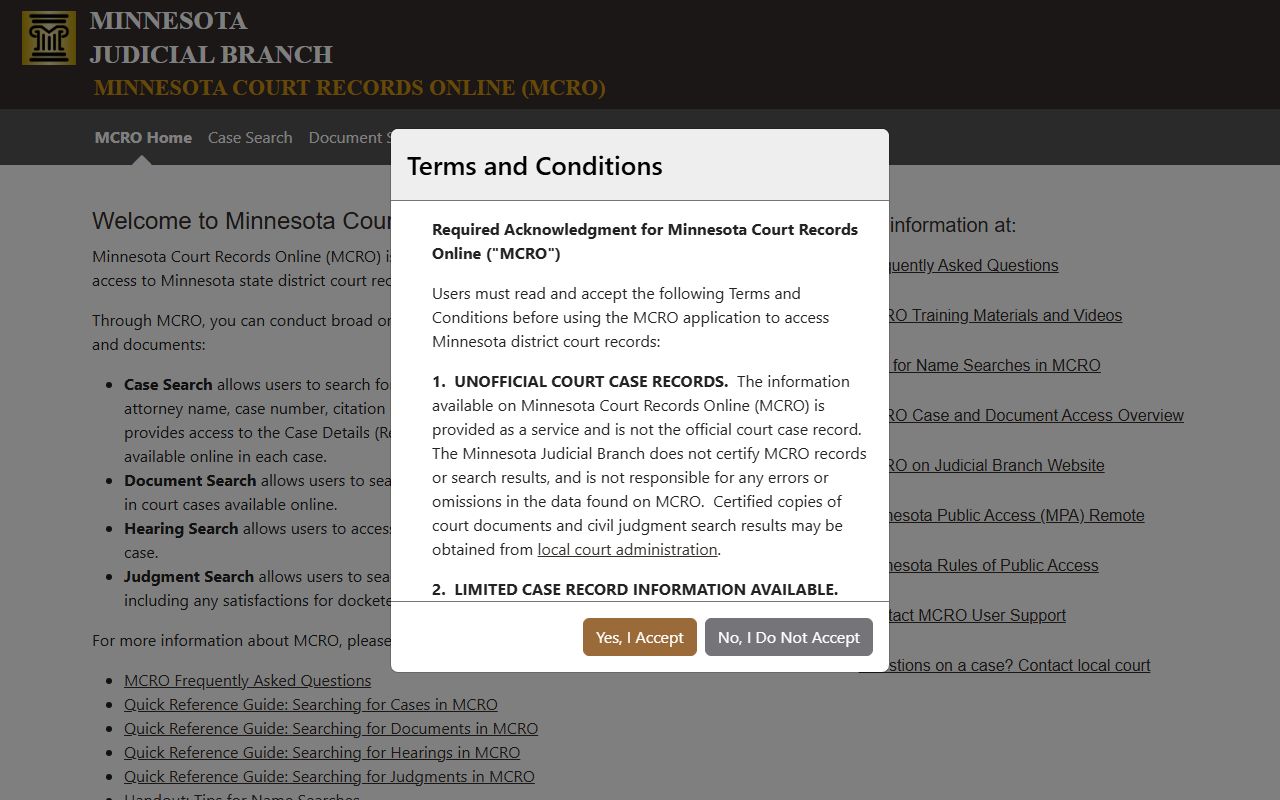
Basic case lookups in MCRO are free. Full document access is $8 per document for registered users.
Note: Court calendars post each morning at 7 a.m. and update hourly throughout the day. They show all cases scheduled at each courthouse that day.
Access Minnesota Case Records
The Minnesota Judicial Branch keeps a dedicated access page at mncourts.gov/access-case-records. This page explains the different ways you can get to court records. It covers the MCRO online portal, free public access terminals at courthouses, and how to request copies from court staff. If you are not sure which method fits your situation, start there.
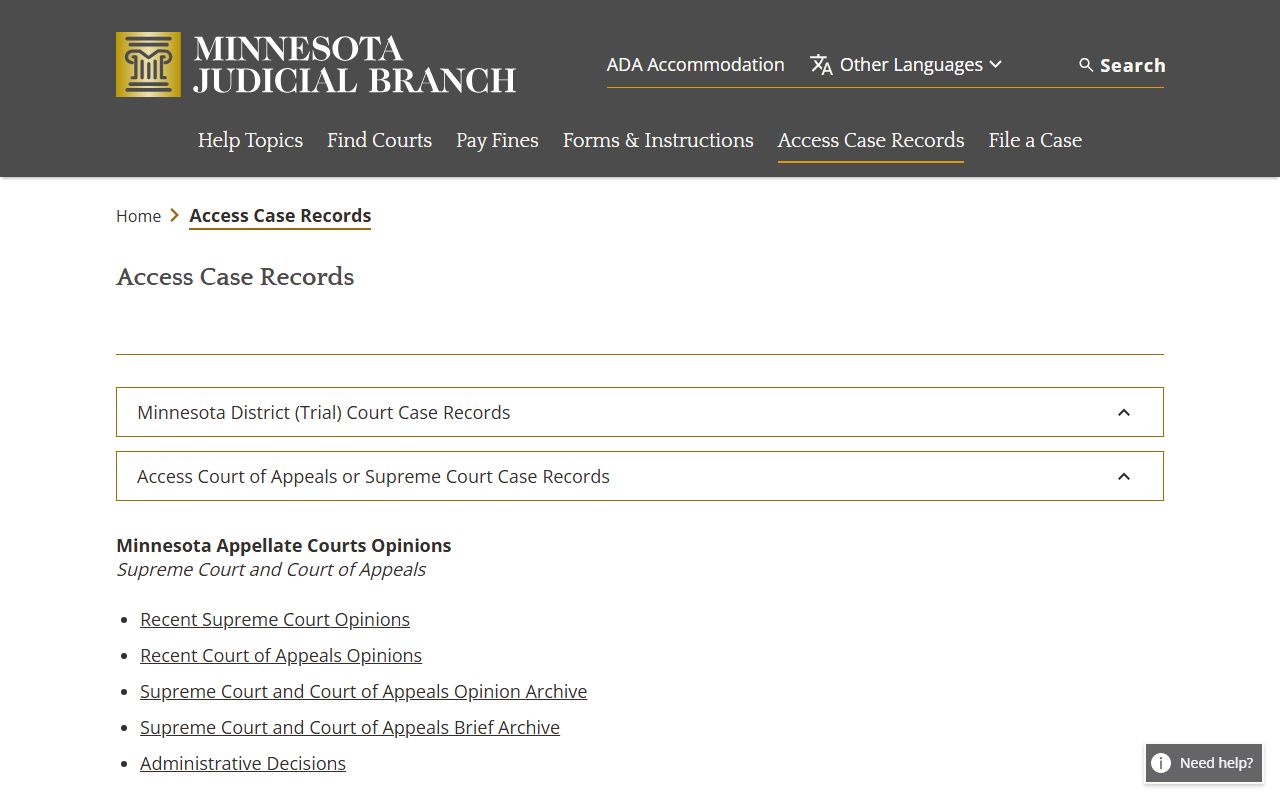
The access page walks you through every option: online search, in-person terminal, mail request, and copy orders through the Court Administrator. It also notes which case types have restrictions on remote access.
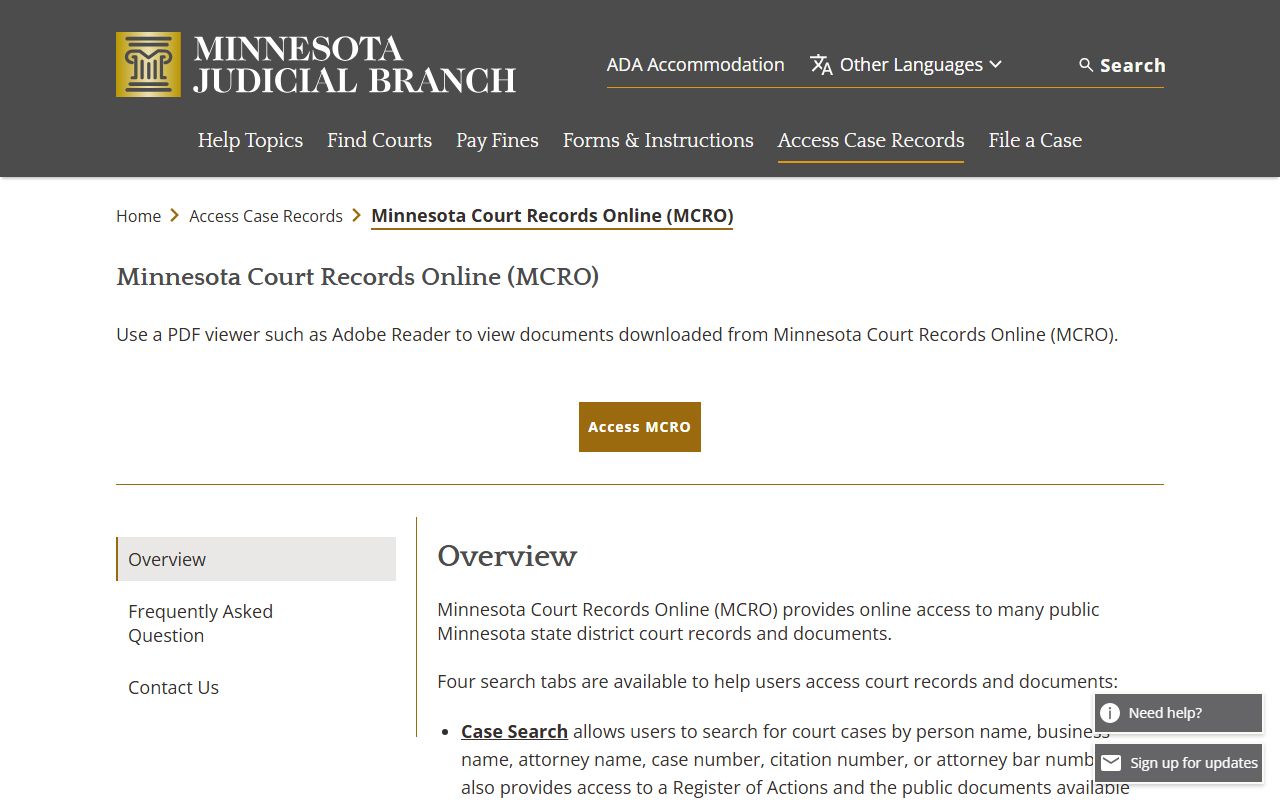
The MCRO information page at mncourts.gov/access-case-records/mcro gives specifics on what the system covers, how to search it, and how to get full document access. It has a quick reference guide and a FAQ for new users. The page also explains which case types are not included in remote access, such as civil commitment, domestic abuse, and juvenile delinquency cases for offenders under 16.
For older court records not in MCRO, the Minnesota Historical Society holds many pre-1900 district court files from counties across the state.
Find a Minnesota Court
Minnesota has 10 judicial districts that cover all 87 counties. Each county has at least one district courthouse. Some larger counties have multiple service locations. The Find Courts directory at mncourts.gov lists every courthouse with its address, phone, court administrator name, and hours. Use it to find the right location before you make a trip.
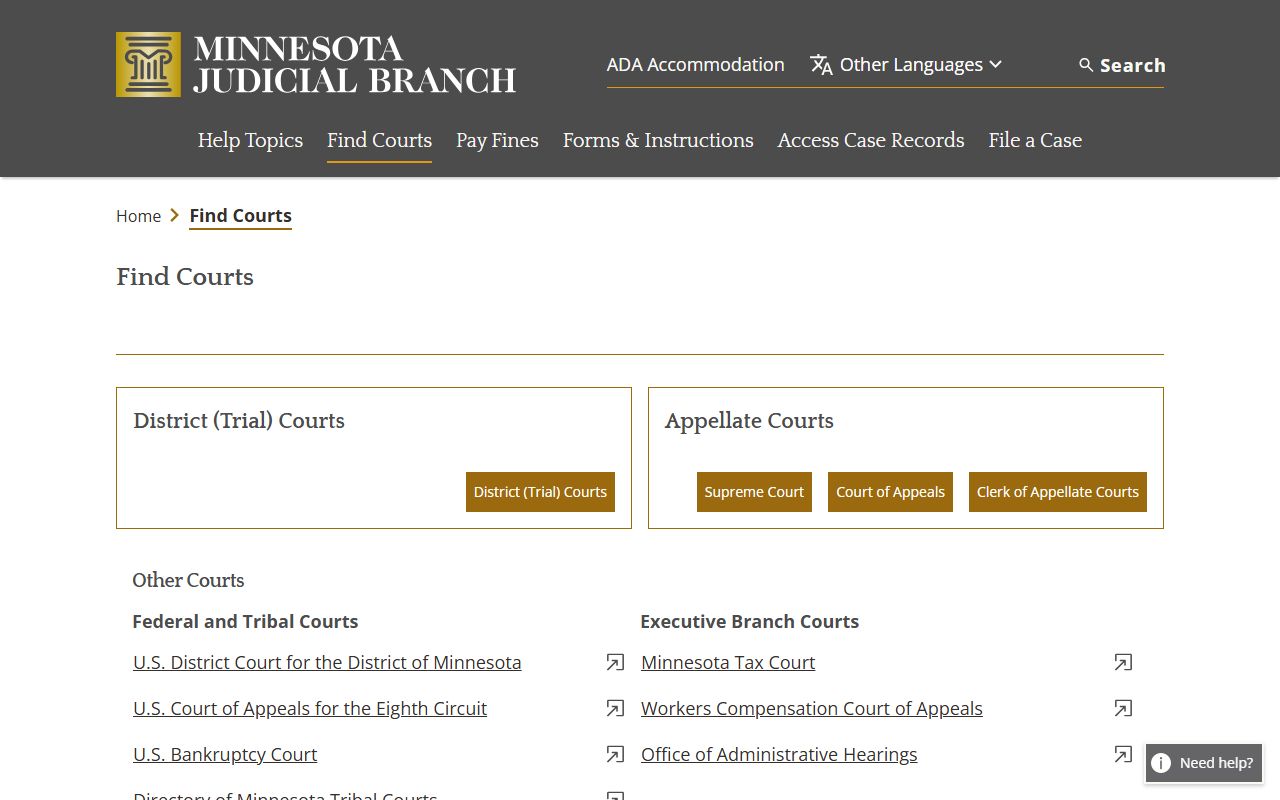
The directory makes it easy to find the exact office that handles your county. Each courthouse page also lists any satellite locations or service centers.
When you visit the courthouse, you can use a free public access terminal to search the statewide court records system. These terminals are in the Court Administrator's office and give you access to MNCIS, the Minnesota Court Information System, at no charge. Staff can also help you find a case by name or number and make copies from the file. Certified copies cost $14 per document. Plain uncertified copies are free at the courthouse window.
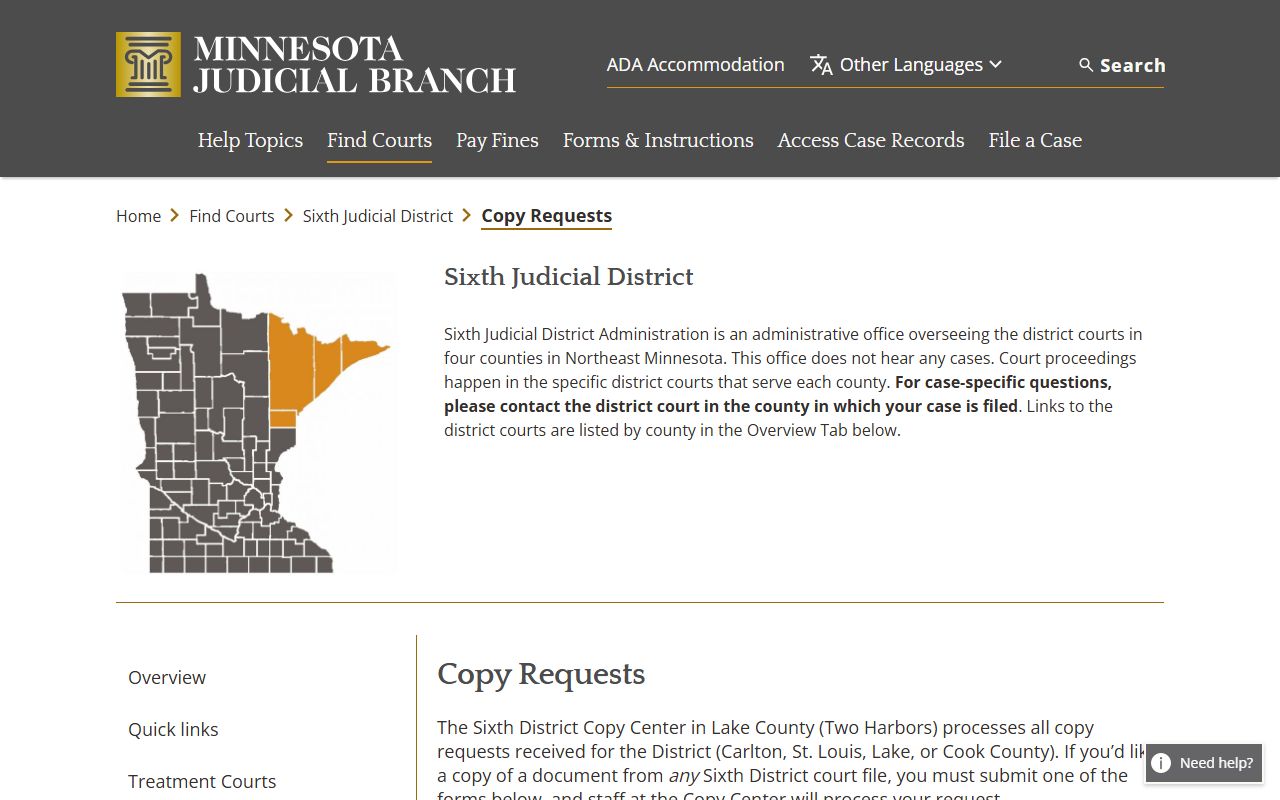
The 6th Judicial District covers Carlton, Cook, Lake, and St. Louis counties in northeastern Minnesota. That district runs a centralized copy center at the Lake County Courthouse in Two Harbors. The 6th District copy request page has full instructions for submitting requests in that region. Call (218) 595-5001, Option 3 for copy inquiries in those four counties.
Planned system maintenance for MCRO typically runs Sundays from 9 a.m. to 4 p.m. and can cause brief outages.
Court Fees and Online Payments
Minnesota courts use a statewide payment system for fines and court fees. You can pay online at webpay.courts.state.mn.us. The system accepts Visa, Mastercard, and electronic bank transfers. A convenience fee of $2.34 applies to online and phone payments. You need your citation number or case number to complete a payment. The system is available 24 hours a day.
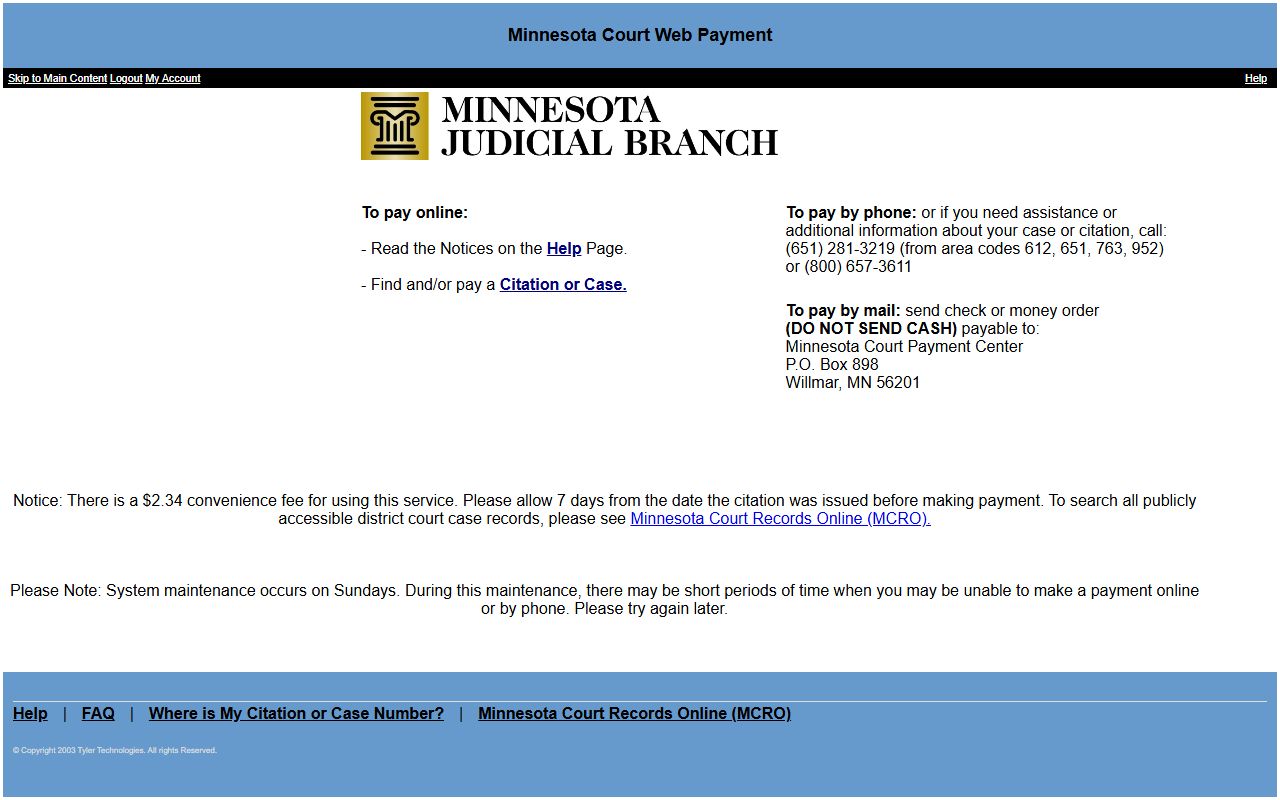
Phone payments go through the Court Payment Center. Call (651) 281-3219 in the metro or 1-800-657-3611 from outside the metro. Mail payments go to: Minnesota Court Payment Center, P.O. Box 898, Willmar, MN 56201.
Standard court copy fees apply statewide. Certified copies cost $14 per document. Exemplified and certified copies cost $28. Plain uncertified copies are free at the courthouse. Scanning fees run $25 per 50 pages. These fees cover court documents, not police or sheriff records, which have their own separate fee schedules set by each agency.
Minnesota Criminal History Records
The Minnesota Bureau of Criminal Apprehension runs a free public criminal history search system. It is separate from the court records system and covers criminal convictions statewide. Search at chs.state.mn.us using first name, last name, and date of birth. Results show public convictions and pending charges that have been entered into the state system.
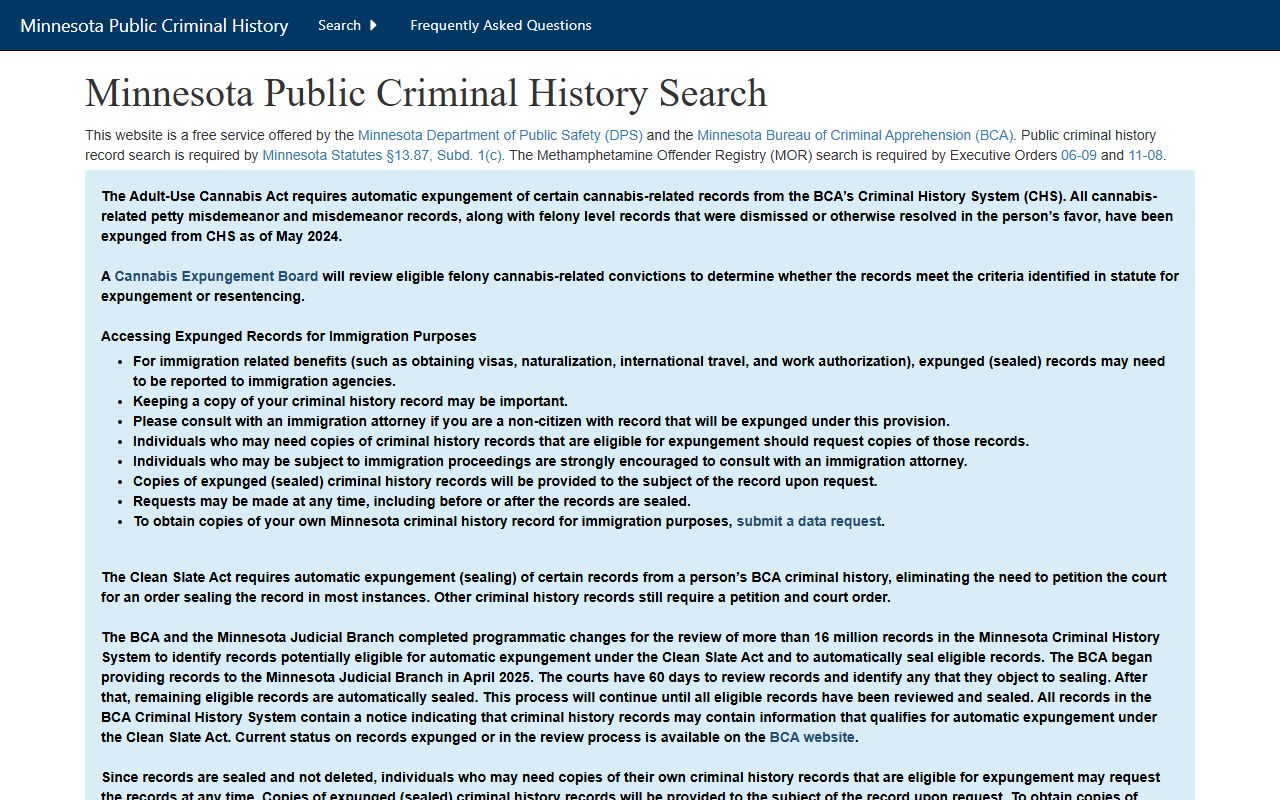
The BCA search is fast and free. No account is needed. It is the quickest way to check public criminal history for a person in Minnesota.
The BCA public system only shows data that is classified as public under Minnesota law. Juvenile records are generally not available. Sealed or expunged records do not appear in the search. The system covers state-level cases but may not include every local or federal charge. For more complete case detail, use MCRO or visit the courthouse in the county where the charges were filed. Under Minnesota Statutes § 13.87, criminal history data held by law enforcement agencies is public for convicted adults. Agencies also maintain data separately under their own data practices policies.
Public Access to Minnesota Court Records
Court records in Minnesota are generally public. The Minnesota Government Data Practices Act, codified in Minnesota Statutes Chapter 13, sets the rules for government data access across the state. All government data is presumed public unless a statute specifically restricts it. Court records fall under this rule. You do not need to explain why you want records. You do not have to be a party to the case to request them.
Under Minn. Stat. § 13.03, any person can ask to inspect public data and get copies. The agency must respond promptly. It can charge a reasonable fee for copies but not for inspection. The Rules of Public Access to Records of the Judicial Branch add guidelines specific to court files and establish which records are accessible remotely versus only in person at the courthouse.
Not all records are fully open. Juvenile court files, civil commitment cases, domestic abuse petitions, and harassment cases have restricted access. Certain data within otherwise public records is also protected, including social security numbers, financial account numbers, and home addresses in some situations. If a court file is sealed, staff will confirm it exists but cannot let you see it without a court order. A party can ask the court to seal records, but judges grant these requests only when a clear privacy or safety interest outweighs the public interest in open records.
Law enforcement records are handled under Minn. Stat. § 13.82. This covers arrest data, incident reports, and related records kept by police and sheriff offices. Arrest records for adults are public. Active investigation data may be withheld. Each agency follows Minnesota data practices rules when responding to requests. Most agencies accept written or online requests and must respond within 10 business days for data subject requests, or as soon as reasonably possible for other requests.
Browse Minnesota Court Records by County
Each of Minnesota's 87 counties has its own district court that handles case filings and holds the official records. Pick a county below to find local contact info and courthouse resources for court records in that area.
View All 87 Minnesota Counties
Court Records in Major Minnesota Cities
Residents of major cities access court records at the district court in their county. Pick a city below to find where to go and how to search court records in that area.